Des Plaines Epoxy Flooring installs basement floor epoxy in Des Plaines, IL, serving surrounding cities including Prospect Heights, Schiller Park, Bensenville, Wood Dale and Norridge. After more than 20 years of coating below-grade floors, we start every basement with the same question: what is the slab doing with water?
Basements are where coatings fail most often, and the reason is almost always moisture rather than the product. A basement slab sits in the ground, and vapor moves up through it all year. Coat that slab without measuring the vapor and the coating can blister, lift and peel from below, sometimes within months.
So the moisture test goes into the written scope before the price is final, and the cracks, spalls and old finishes are mapped at the same visit. If a basement is not ready to coat, because water is still getting in or the slab needs repair, we tell you plainly and explain what has to happen first.
Basement Moisture: Testing Before Coating
Calcium Chloride and Relative Humidity Tests
We measure moisture with ASTM F1869 calcium chloride tests, which report how much vapor the slab gives off over a set period, or with ASTM F2170 probes that read relative humidity inside the concrete. The numbers are compared against the limits published for the coating, and the comparison is shown to you in writing.
A plastic sheet taped to the floor under ASTM D4263 can flag a wet slab quickly, but it cannot tell us how much moisture is moving. We use it as a first look, not as the basis of a quote.
Moisture-Mitigation Primers for Damp Slabs
When readings run above what a standard epoxy tolerates, a moisture-mitigation primer can be applied to the ground slab before the decorative coats. It is a specific product with its own published limits, and it adds cost, so we recommend it from the numbers rather than by habit.
Some slabs exceed even a mitigation primer’s limits. In those cases a coating is the wrong answer, and we say so rather than install a floor we expect to fail.
Efflorescence and Hydrostatic Pressure
White, powdery efflorescence on a basement floor shows that water is carrying salts through the concrete. Hydrostatic pressure from groundwater under the slab can push that water up with real force. Neither problem is solved by a coating, and both are reasons we test and look for drainage issues before recommending a system.
Flooding, Sewers and the River
Basements Near the Des Plaines River and Its Creeks
The Des Plaines River runs along the east side of the city, and Feehanville Ditch, Weller Creek and Higgins Creek cross it. The city’s hazard plan ranks flooding as its top hazard and counts roughly 2,600 structures in the floodplain. A basement with flood history needs a careful look at the slab before it is coated.
Levee 50, the Rand Park levee along the east side of the river, protects thousands of residents, and the city and the water reclamation district have bought out flood-prone homes in the Big Bend neighborhood. Those projects reduce risk, but individual basements still flood from heavy rain and sewer backups.
Overhead Sewers, Backwater Valves and the Flood Rebate
Many basement water problems come up through the floor drain during a storm. An overhead sewer conversion or a backwater valve addresses that, and the City of Des Plaines Flood Rebate Program reimburses 30 percent of the cost, up to $2,000, for qualifying work such as overhead sewers, backwater valves and battery backup sump pumps.
We recommend dealing with the drain and the valve before the floor. Coating first and fixing the plumbing later usually means grinding up a new floor to reach the pipes.
Floodplain Rules and Flood-Resistant Materials
In the floodplain, Des Plaines counts improvements cumulatively over ten years, and whether a given floor project counts toward that total is the city engineer’s call. FEMA Technical Bulletin 2 lists materials that tolerate flood contact. We ask the Building Division about permits and floodplain review before the job rather than assuming the answer.
Choosing a Basement Floor System
Flake Epoxy for Laundry, Storage and Workshops
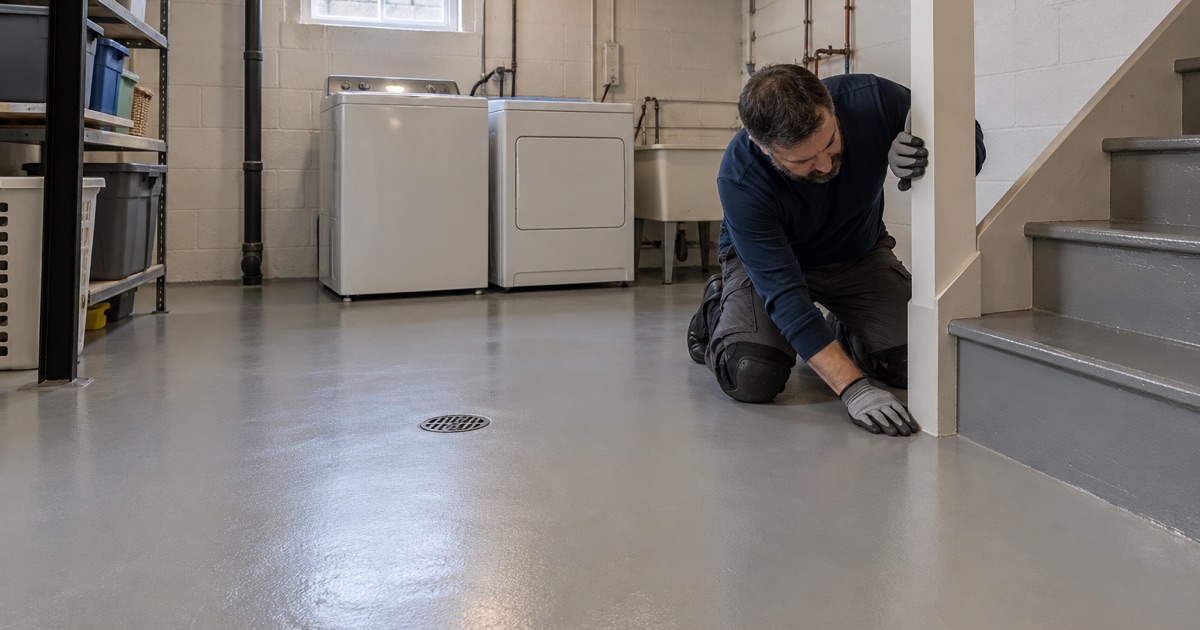
A flake broadcast floor is the most popular basement choice. It hides dust and the small flaws that older basement slabs often carry, cleans up with a damp mop and gives a finished look to laundry rooms, storage areas and workshops.
Metallic and Solid Color Finishes for Living Space
Finished basements used as family rooms, gyms or bars often get a metallic epoxy or a clean solid color. Metallic floors need a flat, well-ground slab, because every bump and old trowel mark shows through the marbled finish, so we grind and patch more carefully before starting.
Topcoats, Sheen and Traction
A polyaspartic or polyurethane topcoat protects the decorative layer and sets the sheen. Satin hides footprints and lint better than high gloss in a busy basement, and anti-slip aggregate can be added near stairs, laundry machines and anywhere water may land.
Older Basements, Old Tile and Black Mastic
Many basements here were finished decades ago with floor tile set in black adhesive, then painted or carpeted over. Before we grind, we ask what is on the floor and how old it is, because some older tile and mastic can contain asbestos and must be tested and handled correctly before it is disturbed. Once the slab is clear, the old adhesive line often reveals cracks and patches that the coating plan has to account for.
Older slabs can also be thinner, softer or more uneven than modern ones. Grinding shows us how sound the surface really is, and where a slab is crumbling or heaving we will tell you it needs repair or replacement rather than a coating.
Our Step-by-Step Basement Floor Epoxy Process
Step 1: Inspection and Moisture Testing
We look for signs of water at walls, drains and the cove joint, ask about flood history, map cracks and old finishes, and set moisture tests. The results decide whether the floor is coated now, primed for moisture, or sent back for drainage work first.
Step 2: Removal and Grinding
Paint, sealer and adhesive are ground off and the slab is opened to the profile the system requires, with dust captured at the machine so the rest of the house stays clean.
Step 3: Crack and Spall Repair
Cracks, pits and spalls are filled with repair materials made to be coated. Moving cracks and slab heaving are flagged, because they can reflect through any coating.
Step 4: Primer and Decorative Coats
A standard epoxy or moisture-mitigation primer goes down first, followed by the base coat and flake, metallic pigment or color. Each layer is applied within its recoat window so the coats bond to one another chemically.
Step 5: Topcoat and Cure
The topcoat seals the floor at the thickness listed in the proposal, and we give you return-to-use times based on the basement’s temperature and humidity. A cool, damp basement cures more slowly, so a dehumidifier running during cure often helps.
Basement Floor Epoxy Cost
What Moves the Price
Moisture readings, the need for a mitigation primer, the amount of old finish to remove, crack repair and the decorative system all change the cost. A dry, sound slab with a flake finish prices far below a damp floor needing mitigation, removal and repair.
Contracts, Warranties and What They Exclude
On home projects above the state threshold, you receive a written contract and the Illinois consumer-rights pamphlet before work begins. We also walk through the coating warranty’s exclusions in advance, and moisture is the first one we name, which is exactly why the testing comes first.
- 20+ Years of Floor Work
- Moisture Test in Every Scope
- Written Proposal, Named Products